
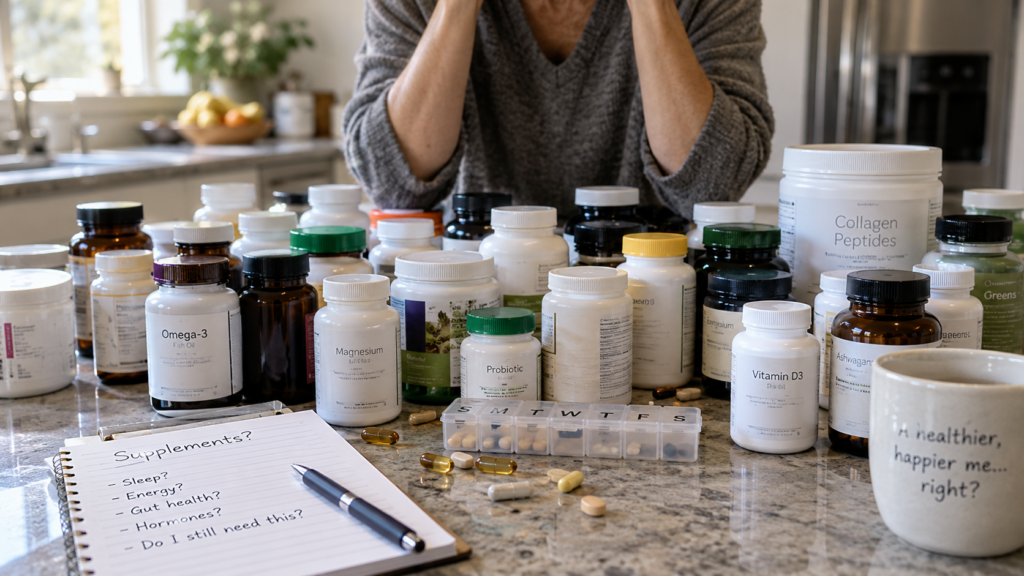
We criticized conventional medicine for having a pill for every problem.
Then wellness built its own pharmacy.
Something for your hormones. Something for inflammation. Something for energy. Something for focus.
Then there are the greens powders, protein powders, electrolytes, adaptogens, mushroom blends and whatever the latest longevity supplement happens to be.
Before you know it, taking care of yourself requires a pill organizer and a spreadsheet.
And here’s the strange part.
You may still not feel particularly well.
So you do what seems logical. You wonder what you’re missing.
Maybe that’s the wrong question.
Maybe you don’t need to add anything at all.
When I’m working with someone, I want to know everything they’re taking.
Not just medications. Everything.
The vitamins. The herbs. The powders. The gummies. The things their doctor recommended. The things another practitioner recommended. The thing their friend swears by. The supplement they read about online.
And, quite often, the bottle they can’t remember why they started taking — but they’ve been taking it for three years anyway.
Sometimes it’s quite a collection.
What interests me isn’t simply the number of bottles.
It’s this:
Has anyone ever looked at all of them together?
Why are you taking each one?
What problem was it intended to address?
Did you actually have a deficiency?
Is it still necessary?
Are several products giving you the same nutrients?
Could one interact with a medication or another supplement?
And perhaps most importantly:
Is any of it actually making you feel better?
I use supplements. I recommend supplements.
There are circumstances in which supplementation can be extremely valuable. A diagnosed deficiency is an obvious example. There are also times when diet alone may not provide what a particular person needs, or when a clinician recommends supplementation for a specific medical reason.
So this isn’t an argument for throwing every bottle in the bin.
It’s an argument for intention.
Because somewhere along the way, supplements stopped being something we used when there was a reason and became part of what we’re supposed to do if we’re serious about being healthy.
And the wellness industry has been very happy to help us with that.
There is always one more thing we could optimize.
This is the part I find fascinating.
We have made health extraordinarily complicated.
And make sure you’re taking them at the right time because this one needs food, that one shouldn’t be taken with food, this one is for the morning and the magnesium is for bedtime.
Good grief.
At what point does the pursuit of health itself become another source of stress?
There is something rather absurd about being anxious because you haven’t completed your wellness routine.
And I wonder whether we’ve started confusing doing more things for our health with being healthier.
They’re not necessarily the same thing.
One of the things I appreciate about Ayurveda is that more is not automatically considered better.
Context matters.
The person matters.
The season matters.
Digestion matters.
The dose matters.
What is useful for one person at one particular time may be completely unnecessary for another.
Even something beneficial can cease to be beneficial when it is inappropriate for the person, the circumstances or the amount.
That’s a very different mindset from:
This is good for you, therefore more must be better.
And it’s one I think we’ve lost in our pursuit of optimal health.
There’s another assumption worth challenging.
Because something is sold as natural, herbal or nutritional doesn’t mean it is incapable of having an effect we didn’t intend.
Supplements can interact with medications. Some nutrients can be harmful at excessive doses. Taking several products can mean unknowingly duplicating the same ingredients.
Herbs aren’t inert either. That’s rather the point.
If a herb has enough biological activity to help you, it has enough biological activity to deserve some thought about whether it’s appropriate for you.
This is why I become uncomfortable when wellness advice is reduced to:
Everyone should take this. Everyone?
There are very few things I would confidently recommend to every human being without knowing anything about them.
I’m not going to tell you to cut your supplements in half.
I’m going to suggest something much less dramatic.
Do a supplement audit.
Take everything you regularly use and put it on the table.
All of it.
Then, for every bottle, ask:
Why am I taking this?
Who recommended it?
What dose am I actually taking?
How long have I been taking it?
What was it supposed to help?
Do I know whether I still need it?
Am I getting the same ingredient somewhere else?
Does my doctor or pharmacist know I’m taking it?
And one question we don’t ask nearly enough:
Has it made a noticeable difference?
Don’t automatically stop prescribed or medically recommended supplements. If you’re unsure about something, particularly if you take medications or have a medical condition, review the complete list with your physician.
The point of the exercise isn’t to get the number of bottles down to some magical number.
It’s to make sure every bottle has a reason for being there.
The wellness industry is extraordinarily good at convincing us that the next thing might finally be the thing.
And perhaps sometimes it is useful.
But before you add the next thing, I’d ask a different question:
What does my body actually need?
Not what does the podcast host take.
Not what does the influencer take.
Not what does the person sitting next to me at yoga take.
What do I need?
Because personalized health isn’t taking twenty-three individually chosen supplements.
Sometimes personalization means recognizing that you don’t need twenty-three things in the first place.
Your health shouldn’t be measured by how many things you take to maintain it.
Sometimes the most sophisticated health plan isn’t the one with the most in it.
It’s the one in which everything has a reason for being there.
If you’re tired of piecing together health advice from different sources and wondering what’s actually relevant to you, that’s what we explore in a Body Blueprint Session.
We look at the whole picture — your history, current symptoms, constitution, lifestyle and the factors influencing your health now — before deciding what deserves your attention.

The Holistic HIghway integrates traditional Western medical practices with Ayurveda medicine, creating a focus on prevention through nutrition, diet, and exercise; use of the latest genetic testing and other diagnostic techniques; and prescribed combinations of botanical medicines, supplements, therapeutic diets, detoxification programs, or stress-management techniques.

Integrative Health Expert | Ayurveda Practitioner | Author | Speaker
Kerry is a globally recognized leader in integrative medicine and the science of health known as Ayurveda. She is passionate about raising awareness of the need for a change in contemporary medicine that focuses on patient empowerment and a health-based (rather than disease-based) medical system.
Kerry is connected with The University of Pittsburgh Center for Integrative Medicine and remains a pioneer in the field of integrative medicine where she has developed a personalized system to manage chronic disorders by incorporating fundamental changes in diet, behavior, and stress while focusing on genetics.
This individualized program is so successful that many of her clients have achieved maximum healing and vitality after years of chronic problems!
More to Explore